Episode Transcript
[00:00:04] Speaker A: During the war, only little information was coming out of Gaza. Since there was no independent investigation, possible information could not be verified and accusations of genocide committed by Israel were made by organizations such as the UN Commission of Inquiry, Amnesty International and various media outlets.
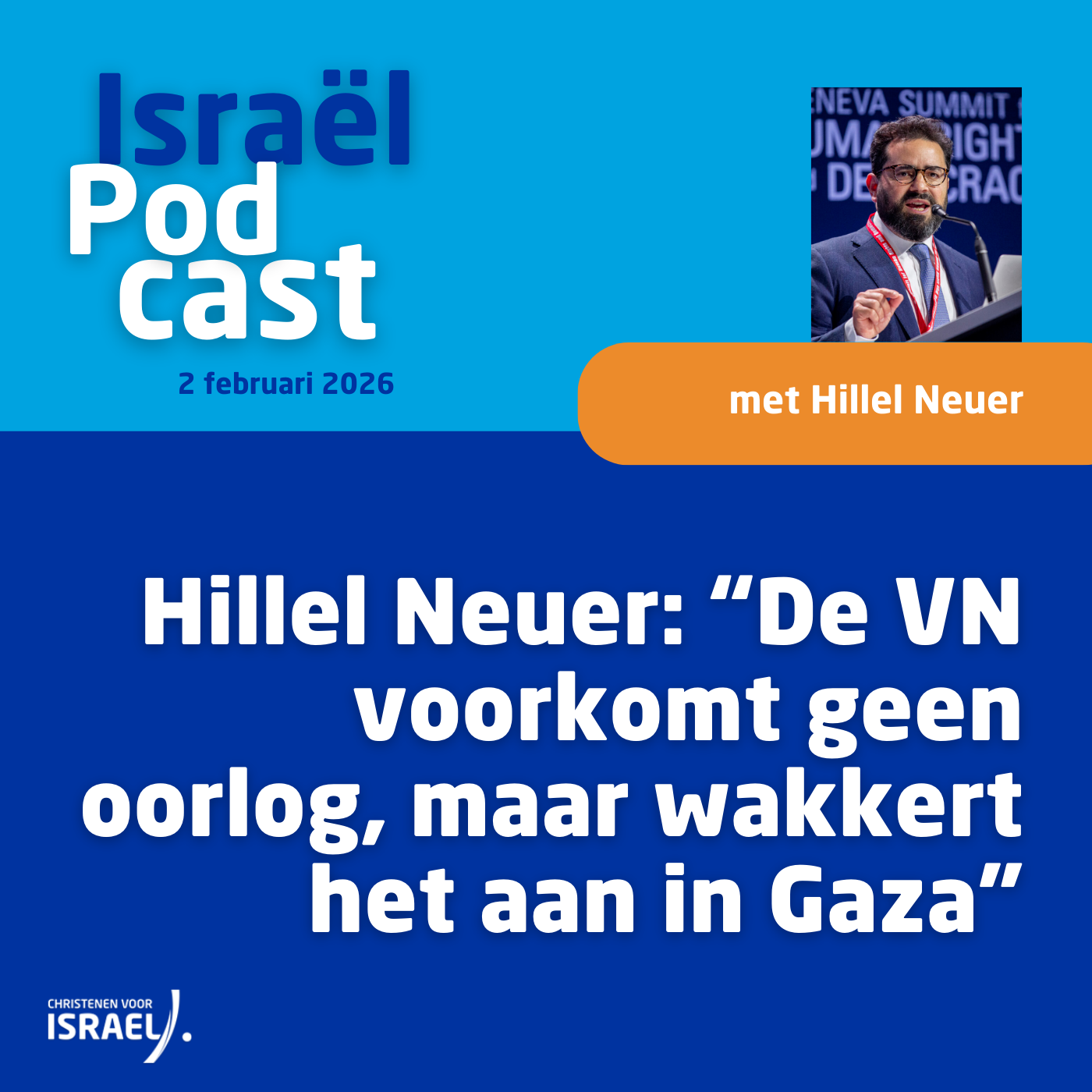
Do we know more now that there is a ceasefire? Today I'm speaking with Hillel Neuer, the Executive Director of UN Water, about this question.
Also about the Board of Peace in Gaza, about Iran, and about the process of peace in Israel and Gaza after the war. Hillel, welcome. In our show recently on Twitter, you said that the UN is very worried about the development of the Board of Peace. Could you explain why you wrote that?
[00:00:52] Speaker B: Look, the United nations sees any credible alternative as a threat to its monopoly of peace and legitimacy. When any new frameworks emerge that expose UN failures, especially if it's in Gaza, the instinct should be self reflection, but it's not.
Instead we see a very strong resistance. The concern does not seem to be about peace coming from the un. It seems to be about loss of control.
[00:01:23] Speaker A: So you think it's not only worries that they have, but they're afraid to lose their control in Gaza, Is that correct?
[00:01:31] Speaker B: Well, the reality is that the UN has very significant power today through UNRWA, which employs 13,000 people and they very much play a critical role there. Sadly, it was a negative rule. They were educating Palestinians to tell them that Gaza is not their home, that their home is in Israel, and that their mission is to return, which for the Palestinians is through Jihad and is dismantling Israel. That's what the UN was doing and they don't want to give up that position. Which is shameful.
[00:02:00] Speaker A: No. Well, talking about organizations such as unrwa, why do we need, in your opinion, why do we need a new organization ruling Gaza, such as the Board of Peace, when there are already plenty of organizations in Gaza working, such as UNRWA, but also NGOs like Borders Without Doctors, Without Borders, etc. Etc. Why do we need other entity rule in Gaza?
[00:02:27] Speaker B: We need other entities in Gaza because existing institutions have completely failed for years. The UN knowingly. Knowingly because we sent them the reports. The UN knowingly funded, legitimized or tolerated actors in Gaza who fuel war instead of preventing it instead of promoting peace. So if existing structures were effective, well, Gaza wouldn't be ruled for the past 15, 20 years by a terror organization. Civilians would not be trapped in an endless cycle of violence.
New mechanisms arise when the old ones show themselves to be unfit for purpose.
[00:03:04] Speaker A: Right. So there is now the Board of peace that is being created. There is also an executive board of 15 Palestinians who would do the executive ruling of Gaza. Do you think they can do a better job in governing Gaza and achieving peace? What is your opinion about this?
[00:03:22] Speaker B: Look, it depends entirely on who those individuals are, whether they're genuinely independent or actually, you know, working for terror groups, which in Gaza. Hamas was subverting almost every organization. So peace requires accountable leadership, rejection of violence.
They need to recognize Israel's right to exist. If those conditions are met, it would already be a radical improvement over the status quo.
[00:03:48] Speaker A: So what are the signals up until now? Because we know already from the board of Peace who is taking place in it. For example, Turkey will take place in it, Qatar will take place in it. Are you trustful that this will be a solution that will actually work for Gaza and for Israel?
[00:04:06] Speaker B: The jury is out. As you indicated, some of the regimes that President Trump has been inviting, whether it's Turkey or Qatar, have horrible records of supporting Hamas. And if they're really allowed to have significant influence, then this is going to not be the solution we need.
[00:04:23] Speaker A: So what are the steps that should be taken, according to you, to receive a sustainable peace in Gaza?
[00:04:30] Speaker B: Well, the first thing, obviously, and President Trump has said so, is to permanently remove Hamas from power.
Second, you need to end this glorification of violence in the schools, which was happening at unrwa, you, and also in the media, in part groups like Al Jazeera, funded by Qatar. Third, you need to ensure aid, humanitarian aid, is demilitarized and strictly monitored, not to be used by Hamas. Finally, one needs to guarantee Israel's right to defend itself while ensuring reconstruction that is tied to accountability, not terrorism. So if the money that's coming from the international community is going to, as it did in the past 20 years, to build hundreds of miles of kilometers of terror tunnels, then we're just going to have a repeat of October 7th. That's got to stop.
[00:05:14] Speaker A: Exactly. Now that the ceasefire has been in place already for a few months, three months, there is more information coming out of Gaza because during the war, we saw that it was very hard to get the facts from Gaza because there was no free press, because it wasn't possible to do, like, independent investigation about what's actually going on there. Is it possible at this moment, like, three months after the ceasefire, to get independent information from Gaza?
[00:05:43] Speaker B: You know, only partially. Okay. Gaza still has no free press. Journalists are operating under intimidation. Hamas remains deeply embedded in the civilian infrastructure. Now, there's some additional information that emerges during the ceasefire, but claims still need to be treated with caution and need to be verified independently.
[00:06:03] Speaker A: Because in September, from last year, the UN Commission of Inquiry has stated that there was a genocide taking place in Gaza committed by isra.
Because before we dive deeper into this subject, can you explain, in short, what is the UN Commission of Inquiry?
[00:06:24] Speaker B: The UN Commission of Inquiry was created after the war of May 2021 between Israel and Hamas.
The commission began with very strong prejudice. Keep in mind the chair they appointed, Navi Pillay, had accused Israel and had lobbied countries to sanction Israeli apartheid. Okay, this is two years before she was appointed. So this is someone who was an activist accusing Israel of apartheid, lobbying countries to sanction Israel. She was made the objective chair. So this was a bad joke. It's sort of a kangaroo court almost, you know, like a Stalinist show trial. Had the pretense of three judges who supposedly are independent and objective, but in reality, as it was in Stalin, the verdict by the UN was determined in advance. The only thing that this commission has tried to do is to go after Israel here and there. Marginally they mention Hamas, but it's never been their focus. Keep in mind, one of their members, Milun Kothari, was condemned by the Netherlands, France, Germany, Sweden, Canada by 18 countries for antisemitism because he talked about lobby controlling social media.
He's the first UN Commission of Inquiry member to be condemned by 18 democracies for anti Semitism. And they kept him on. Only until recently did they switch some of the members. But they defended him. The chair defended him. So this is an extremely biased commission, really weaponized for a political agenda, nothing to do with a neutral, independent or objective inquiry.
[00:07:58] Speaker A: So does the ceasefire that has now been in place for three months, does it help to get more information concerning this accusation? Because in September they said there is a genocide going on in Gaza.
How is the information coming out right now?
[00:08:14] Speaker B: Well, look, that accusation was absurd from the beginning. We saw when Israel went into the Iranian airspace, in 12 days, they managed to destroy all of Iranian air defenses. They destroyed part of their nuclear facilities. They took out, you know, extraordinary firepower by Israel in Iran and clearly the Israeli air force. If they wanted to kill people in Gaza, it wouldn't take them two and a half years. And sending their troops into, you know, tunnels. They could have done it in three hours if they wanted to kill hundreds of thousands of people. So the genocide accusation is a complete lie. Israel fought a defensive war against, against brutal radical Islamist terrorists, a death cult called Hamas, which invaded Israel on October 7, massacred more than a thousand People committed rape and other atrocities against families. Israel was defending itself to make sure that October 7th wouldn't happen again. Hamas embedded themselves deliberately under Palestinian homes, knowing they would incur civilian casualties. But keep in mind that the genocide accusation was made without access to any Israeli evidence, any military decision making or Hamas command structures.
So the evidence they had is meaningless. A ceasefire that we have now does not retroactively validate a politically charged allegation that was legally unsound right from the start.
[00:09:39] Speaker A: Do you think Israel has a fair chance in defending itself against these accusations of genocide? Because in the International Court of Justice, this is also a case that's going on and will probably take for a few years. Do you think they have a fair chance in defending themselves, or has the version already been made?
[00:09:57] Speaker B: Look, Israel can and does defend itself vigorously, but many of these proceedings, especially when they're connected to UN institutions, they suffer from very deep politicization, predetermined narratives. Look, legal process matters, but so does recognizing when law is being weaponized for a political agenda.
[00:10:17] Speaker A: All right, let's go to our final topic, because last week the European Union announced that they will be listing the Islamic Revolutionary Guard as a terrorist organization. What do you think of the step that they are taking?
[00:10:31] Speaker B: Look, it's long overdue. We welcome it. We called for it for years, and especially in the past several weeks, I went to Paris to urge France to change their position. Luckily, yesterday they did. The Islamic Revolutionary Guard Corps is the central engine of repression in Iran and terrorism across the region and also in the world. They try to assassinate people in the Netherlands, in the United States and other countries, whether it's Hamas, Hezbollah, militias in Syria and Iraq. IRGC is behind the terrorism. Finally, the EU called them what they are.
[00:11:02] Speaker A: So what is the importance of this step of the eu? Is it important? Is it valuable?
[00:11:08] Speaker B: Well, we think it is important because it targets the regime's core. It weakens the irgc, that weakens Tehran's ability to export violence, to suppress its own people. They killed estimated 30,000 people, if not more. And this is a prerequisite for any serious path for a future of Iran that respects the rights of its own people and respects peace in the region.
[00:11:29] Speaker A: So in what way does it have a consequence for the irgc?
Is it only a symbolic step of the eu, or is there real consequences connected to the fact that they are now seen as a terror organization?
[00:11:44] Speaker B: Well, look, I think when symbols and messages are important, they send a signal to the world. And the signal was sent from the EU that that it's no longer business as usual. The approach of the Iran deal, the jcpoa, that's finished. This is a new position by the eu. If it's enforced properly, it has potential for real consequences. Talking about asset freezes, prosecutions, travel bans, disruption of financial networks. And you know, it's the signals, the messages, the symbols will only become empty if the governments fail to act. But we hope the governments will act.
[00:12:20] Speaker A: On the other hand, you could say that Hamas is already for a few years on the terror list of the eu, but they are still in power in Gaza. So what is the actual pressure that the EU can give in this matter?
[00:12:33] Speaker B: Absolutely. Look, these kinds of messages are the beginning of a pathway, but it's definitely not the end. Designation on a terrorist alone is not enough. It must be paired with enforcement, isolation, removal of governing power. Hamas remains in Gaza precisely because these things didn't happen. The international community too often funded the authorities in Hamas through unrwa, which the money basically was used to help Hamas without dismantling the terror infrastructure. So, yes, designation is important, but it is not sufficient if they don't follow through on all the measures that we've discussed.
[00:13:09] Speaker A: So what should happen next, according to you? What is the road towards a peaceful Iran, that peace between Israel and Iran, according to.
[00:13:18] Speaker B: Well, the first thing that has to happen is the regime has to stop killing its own people. And it's not going to happen until the regime ends, let's be honest. So the regime needs to end now. We need to do everything we can to support the people of Iran to replace this regime with authorities who will not kill their own people. And we know that the Iranian people are very strong. They are. Actually. There's a very strong middle class, very rich culture that supports democracy and human rights. Very pro Western, very anti Islamist, other than a small 10%, maybe more hardcore. So there is great future, but this regime has to end. We have to do everything to support measures that will end this regime now, to stop the killing.
[00:13:57] Speaker A: Final question, Hillel. Are you optimistic about the future of Iran? The near future?
[00:14:05] Speaker B: Yes and no. I mean, the no is we don't know when the regime will end and they're prepared to take any measures. We know that they. The instructions were show no mercy. They slaughtered, they say in two days, at least 30,000 people, according to Time magazine and other sources.
So that part is very pessimistic. The optimistic is the regime cannot survive. This is now a zombie regime. It looks like it exists, but it clearly is half dead. It has no future. Whether it'll be a week, a month, more, we don't know. But this regime will come to an end. And we have great hopes that the people of Iran will restore their terrific culture and hopefully you'll have a democracy which will change not only Iran, but the entire region.
[00:14:52] Speaker A: Hillel Neuer, thank you very much.
[00:14:55] Speaker B: Thank you.